← Articles
AI Can Copy Your Writing Style. It Still Won’t Sound Like You
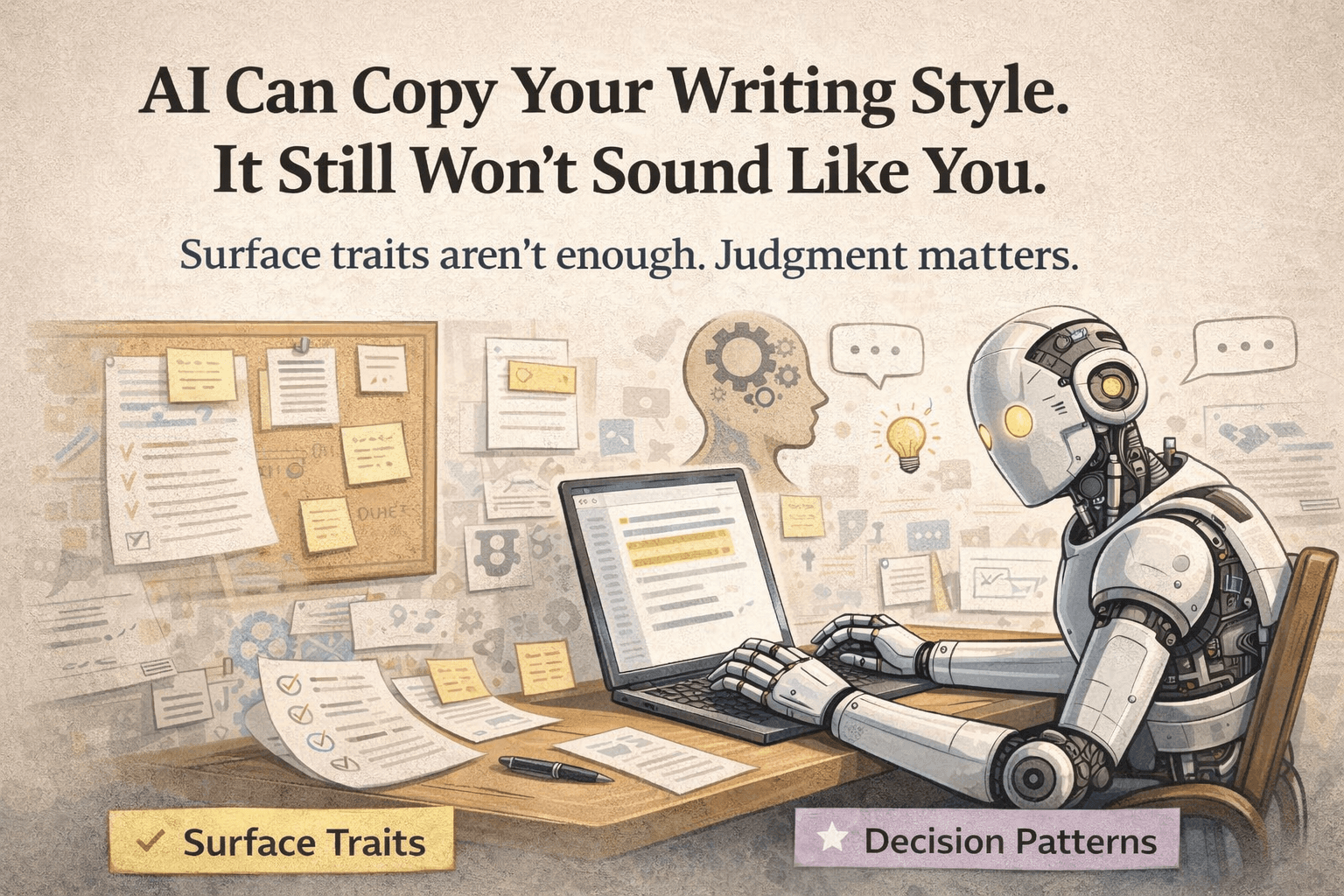
AI Can Copy Your Writing Style. It Still Won’t Sound Like You.
Most tools that claim to “write in your voice” don’t actually do that.
They imitate surface traits.
Sentence length.
Word choice.
Formatting.
That’s why the output feels close, but never quite right.
Your voice isn’t just how you write.
It’s how you decide what to say.
This matters more than ever as AI becomes embedded in marketing, content, and distribution workflows. The difference between standing out and blending in is no longer quality. It’s judgment.
Why “Writing Style” Is the Wrong Starting Point
When people say they want AI to write “in their voice,” they usually mean:
Tone
Vocabulary
Rhythm
That’s maybe 30% of the equation.
The other 70% lives underneath:
What you don’t say
When you stay brief
When you challenge instead of agree
Which ideas you ignore entirely
Most AI writing tools never touch this layer. They optimize for fluency, not decision-making.
That’s why so much AI-generated content feels technically correct but emotionally flat.
Why Uploaded Samples Aren’t Enough
Uploading past tweets, blog posts, or emails does help.
But it only teaches AI what you’ve written, not how you choose.
Two founders can use similar language and arrive at completely different conclusions. Two marketers can describe the same tactic but prioritize entirely different tradeoffs.
Without learning:
Preference
Restraint
Pattern over time
AI defaults to averages.
That’s where “AI-coded” comes from.
The Hidden Layer: Decision Patterns
To actually sound like you, AI needs to learn behavioral signals:
How often you reply versus observe
How strong your opinions tend to be
How direct you are when you disagree
How much context you assume the reader already has
These aren’t text features. They’re decision patterns.
They don’t show up in a single sample.
They emerge over time.
This is why most “voice matching” tools fail. They model output, not intent.
Why Most AI Writing Feels Wrong on X and LinkedIn
Most AI systems are trained to:
Over-explain
Hedge language
Avoid sharp edges
Humans don’t write that way on social platforms.
Real writing includes:
Friction
Compression
Selective confidence
When AI smooths those edges, it stops sounding human. More importantly, it stops sounding like you.
In growth marketing, this is fatal. Distribution rewards clarity and judgment, not politeness.
How to Train AI Without Losing Authenticity
The goal is not to make AI sound human.
The goal is to make it sound like you.
That requires a different approach:
Teach preference, not personality
Preserve restraint
Allow silence as a valid output
A system trained this way won’t generate more content.
It will generate fewer, better responses.
That’s what real leverage looks like.
Why This Matters for Growth, Marketing, and Founders
As AI adoption increases, generic output becomes a liability.
People will trust:
Consistent voices
Clear judgment
Recognizable patterns
They won’t trust:
Perfectly worded replies
Endless agreement
Over-participation
Voice is becoming the moat.
For founders, operators, and growth leaders, this isn’t about branding. It’s about credibility at scale.
AI Voice vs AI Digital Twin
This approach is the foundation of an AI digital twin.
An AI digital twin doesn’t just write for you. It learns when to speak, when to stay quiet, and how to preserve your judgment under scale.
If you want the full breakdown, read:
What Is an AI Digital Twin? (For Founders, Creators, and Operators)
Final Thought
The real risk with AI isn’t sounding artificial.
It’s sounding average.
Training AI on your writing style only works when you train it on your judgment, not just your words.
FAQ
What does “AI writing in my voice” actually mean?
It means preserving how you think and decide, not just how you phrase sentences.
True AI voice matching captures:
Restraint
Preference
Opinion strength
Consistency over time
Most tools only copy surface-level writing patterns.
Why does AI trained on my writing still sound generic?
Because most systems learn text, not judgment.
They don’t understand:
What you would ignore
When you stay brief
When you push back instead of agreeing
Without these signals, AI defaults to average responses.
How do you train AI on your writing style correctly?
Proper training requires:
Behavioral patterns over time
Examples of what not to say
Context around when you choose silence
This produces fewer but more accurate outputs.
Is AI voice the same as voice cloning?
No.
Voice cloning usually refers to audio.
AI voice for writing refers to tone, cadence, and decision patterns in text.
Can AI learn personal judgment?
Yes, but only if the system is designed to learn preference rather than personality.
Judgment shows up in:
Selective engagement
Consistent boundaries
Repeated patterns across contexts
This is the core of an AI digital twin.
Who benefits most from AI voice training?
AI voice training is most useful for:
Founders building in public
Growth and GTM operators
Creators who value consistency
Professionals active on X and LinkedIn
If your reputation is tied to how you communicate, voice matters.