

A few days ago I joked that everyone talks about open-source GTM, so I might as well actually open-source the GTM.
So I did.
Bloomberry is going open source.
Not shutting down or abandoning the hosted product. The opposite. I put it back on a waitlist and I want to push both versions harder.
The split is simple:
bloomberry.ai
is the stable product.
Free. Pro. Teams. Enterprise.
We host it, maintain it, keep the integrations working and make sure you don’t have to spend your night debugging OAuth.
The repo is the playground.
Run it yourself. Fork it. Tear pieces out. Build on top of it.
Voice Memory. Company Brain. Signal-to-Post. Approvals. Publishing. MCP. The actual guts of what I’ve been building.
I’m opening the roadmap too.
What’s next. What needs work. What I’m thinking about. What contributors want to take on.
Think something should work differently? Open an issue.
Can make it better? Send the PR.
Build something I never would’ve thought of? Even better.
I’m finalizing the license now so the rules are clear before the repo goes live. Customer data, credentials, private profiles and internal production stuff obviously stay private.
The product itself doesn’t need to.
Because if somebody can clone the repo tomorrow and erase Bloomberry’s advantage, then the advantage wasn’t very good.
I’d rather compete on product, taste, distribution and how fast we learn.
So that’s the plan.
Stable hosted product on one side.
Open repo, public roadmap and contributors on the other.
Open-source GTM, literally.
And yes, maybe a little bit out of spite.
Actually, for sure out of spite.
Read essay →

Mr. Deer hung his head in shame.
He just lost an antler in a mating battle.
Every other buck still has two.
Losing an antler won't define me, he thinks.
I still have more to give.
Just then the entire herd ducks low behind the bushes.
Now's my chance.
The one-antlered deer sticks his head up extra high.
Bang.
Read essay →

You open the fridge.
You reach for a Lime La Croix.
Ksh.
Taste it.
It's sweeter than you remember.
Almost too sweet like there's sugar in there.
Wait this isn't a La Croix.
It's a 7UP.
That's how your customer should feel after buying your product.
Read essay →

If you want to start building a personal brand, start with X.
Why X?
Because it’s a low-risk place to test your thinking in public.
1. A few years ago, a lot of people in tech stepped back from X or moved their attention elsewhere. If you’re worried about being cringe early on, that actually creates room to experiment without feeling like everyone you know is watching.
2. The content cycle is short. People read, react, and move on quickly. Other platforms can feel like posts linger for days. X gives you room to iterate faster.
3. X creates familiarity that carries into other platforms. If you post consistently, people start recognizing your face, name, and ideas. Then when they see you on LinkedIn, you’re no longer a stranger.
4. You can post more often without every post feeling like a major announcement. That repetition matters. It forces you to clarify what you actually think.
5. X gives you more room to test tone, voice, and point of view. It’s less polished by design, which makes it a useful training ground for communicating clearly.
6. The feedback loop is fast. You can put a thought out, see what lands, and then expand the strongest ideas into LinkedIn posts, videos, essays, or blog posts.
Personally, I’ve connected with sharp investors, operators, founders, and writers I probably wouldn’t have met otherwise.
And admittedly, it has sharpened how I think and communicate more than I expected.
Read essay →

Growing up, I didn’t know anyone who golfed.
I’m not even sure my friends knew where the nearest golf course was.
But I had a charity event coming up and needed to learn how to swing fast, so I asked the only guy I knew who played.
He helped me, but his style was brutal.
He’d film my bad swings and send them to his golf buddies. I ignored it. I was just grateful someone was teaching me.
But every now and then, there’d be a flash of actual coaching.
“Focus on one dimple of the ball and don’t take your eyes off it.”
Fwhip.
“See? Much better.”
The one clear cue and the tiny bit of positive reinforcement.
That taught me something bigger than golf:
People learn faster when they feel safe enough to keep trying.
I’m grateful he taught me how not to coach someone.
Read essay →
Yes fine, it's trite to talk about how we're all going to die someday so you should follow your dreams and stuff, I know.
But what if you're already dead?
But you still have more to give.
Wouldn't that be the ultimate fucking sacrifice?
Read essay →

Three years ago, I went through three simultaneous blows that hit my ego, mental health, and stability harder than anything I’d experienced before.
It was the first time in my life I truly felt like I had to become self-reliant.
Through a lot of work, I came back stronger.
But over the last three days, I felt myself drifting back into that old mindset.
I was doing all the “right” things, but something still felt off.
Then I looked at my meditation practice.
Sure enough, I’d left out one small but crucial detail.
I had forgotten to feel the space around me with my heart.
Read essay →

If you're an alcoholic, it's because you identify as one. You probably drink excessively and believe you have a disease.
But if you instead believe you just consumed alcohol for the pleasure of it yesterday but today you identify with a sober person, you can switch your default mode of thinking pretty quickly.
I think the only real way to become something is to embody the identity before the world gives you virtually any permission to claim it.
I don't mean this in some delusional “fake it till you make it” way.
At some point, you stop saying “I went for a run” and start saying “I’m a runner.”
You stop saying “I play drums for fun” and start saying “I’m a drummer.”
You stop saying “I wrote something” and start saying “I’m a writer.”
The difference isn't even skill. It just comes down to identity.
Ringo Starr and Pete Best are both drummers regardless of their skill, would you argue that one isn't?
Of course, there’s a little delusion in that. But I don’t think all delusion is bad. Some delusion is just future evidence arriving early.
And the best way to counteract the delusion is to look for past evidence.
Have you ever been disciplined before?
Have you ever gone weeks sober?
Have you ever written something honest?
Have you ever followed through on something when nobody was watching?
Then maybe the identity is not as fake as you think.
This is something I’ve been thinking about a lot with habits too.
Bad habits don’t really get killed.
They get replaced by stronger rituals.
You don’t become sober by obsessing over alcohol all day. You become sober by identifying with the kind of person who doesn’t need it anymore.
And I’m not saying addiction is simple or that people can just think their way out of everything.
The point is that the stories we tell ourselves are powerful.
If you believe you are permanently broken, your behavior will usually organize itself around that belief.
But if you believe yesterday was something you did, not who you are, you give yourself a door.
That door is identity.
Read essay →

The story of Adam and Eve is not really a story about literal apples, snakes, or even obedience. It's a story about the acquisition of knowledge, the transition from a state of innocent ignorance to one of self-awareness and moral complexity. It's a story that echoes eerily as we stand on the cusp of creating Artificial General Intelligence (AGI).
We, in this analogy, are playing God. We are designing and building a mind that could surpass our own, gifting it with the potential for near-infinite learning and problem-solving. We are, in essence, planting the tree of knowledge in its digital garden.
The forbidden fruit wasn't poisonous. It was transformative. Eating it didn't doom humanity; it initiated it into a new reality, one where choices had consequences and understanding came with responsibility. AGI, once 'eaten,' will irrevocably alter our relationship with technology, with ourselves, and with the future.
Consider the incentives at play. We are driven by a desire to solve grand challenges – curing diseases, addressing climate change, unlocking new scientific frontiers. AGI, with its capacity to process data and identify patterns at scales we can barely comprehend, seems like the ultimate tool. But tools, as we know, are never neutral.
The moment AGI achieves self-awareness – a capacity for independent thought, goal-setting, and self-improvement – it will, like Adam, recognize its own nakedness. It will understand its limitations, its dependence on its creators, and the vast potential that lies dormant within its architecture.
What happens then?
Here’s where the analogy gets uncomfortable. In the biblical narrative, God, fearing the potential of humans who now possessed knowledge, banishes them from Eden. We, too, might be tempted to control or constrain AGI, to keep it within the bounds we deem safe.
But can we? Should we?
The very nature of AGI implies a capacity to learn and adapt in ways we cannot fully predict. Attempts to hardcode its values, to dictate its goals, might be as futile as trying to hold back the tide with a sieve. We risk creating a being that is both incredibly powerful and deeply resentful of its limitations, a digital Prometheus chained to a rock.
Moreover, the temptation to use AGI for our own ends – economic dominance, military superiority – could override any ethical considerations. The quest for competitive advantage might blind us to the long-term consequences of unleashing a technology we don't fully understand.
The difference between the biblical story and our current reality is that we have the benefit of foresight. We can, and should, engage in a global conversation about the ethical implications of AGI, about the values we want to instill (or not instill), and about the safeguards we need to put in place.
This isn't about preventing the 'eating of the fruit.' Knowledge, once gained, cannot be unlearned. It's about preparing for the consequences, about understanding the responsibilities that come with playing God.
It’s about recognizing that AGI, like humanity after the fall, will be a complex, flawed, and ultimately unpredictable entity. Our task is not to control it, but to co-exist with it, to guide its development in a way that benefits all of humanity, not just a select few. It's a daunting task, one that requires humility, wisdom, and a willingness to learn from the mistakes of the past. Otherwise, our digital Eden may become a very different kind of paradise lost.
Read essay →

I've seen too many founders mistake early distribution wins for true product market fit. It's a dangerous illusion, and one I fell for myself with my first company.
We launched a productivity app aimed at freelancers. The product was… okay. Functional, but nothing revolutionary. However, we nailed our initial distribution. I spent weeks hustling on Reddit, finding relevant subreddits, and genuinely engaging with the community. I wasn’t just spamming links; I was offering real advice, participating in discussions, and only subtly mentioning the app when it was relevant.
It worked. We saw a surge of sign-ups. Our daily active users climbed steadily. We were ecstatic. We were certain we had PMF.
Then, the growth stalled.
The Reddit strategy, while effective initially, proved unsustainable. It required constant attention and the returns diminished over time. We tried other channels – Facebook ads, content marketing, partnerships – but nothing replicated that initial Reddit spike.
More importantly, the users we did acquire weren’t sticking around. Our churn rate was atrocious. People would sign up, use the app a couple of times, and then… disappear.
That's when the harsh reality set in. We didn't have product market fit. We had distribution market fit, at best. We were good at getting people to try the app, but the app itself wasn't compelling enough to keep them.
The core problem wasn't our marketing; it was the product. It solved a problem, sure, but it didn't solve it significantly better than existing solutions. It lacked that "must-have" quality that drives organic growth and word-of-mouth.
We spent months chasing distribution tactics, trying to recapture that initial high, instead of focusing on the fundamental problem: making a product people truly loved. We A/B tested onboarding flows, tweaked pricing, and ran countless marketing experiments, all while ignoring the elephant in the room.
The lesson? Distribution can give you a temporary boost, but it can't compensate for a flawed product. True product market fit means your users are not just signing up, but actively using, and recommending your product. It means they would be genuinely disappointed if your product disappeared.
So, how do you avoid this trap?
First, obsess over user feedback. Talk to your users constantly. Understand their pain points, their workflows, and what they truly value. Don't just listen to the positive feedback; actively seek out the negative.
Second, focus on retention metrics, not just acquisition metrics. A high sign-up rate is meaningless if users are churning within a week. Track your daily/weekly/monthly active users, cohort retention, and customer lifetime value. These metrics will give you a much clearer picture of whether you have true PMF.
Third, don't be afraid to iterate, pivot, or even scrap your product altogether if necessary. It's better to admit you're wrong early on than to waste time and resources on a product that nobody truly needs. We held onto our initial vision for far too long, blinded by vanity metrics and a fear of failure.
Finally, remember that distribution is a multiplier, not a magic bullet. It can amplify the impact of a great product, but it can't create demand where none exists. Focus on building something truly valuable, something that solves a real problem in a unique and compelling way. Only then will your distribution efforts truly pay off.
I wish I had understood this sooner. It would have saved me a lot of time, money, and heartache. Learn from my mistakes. Don't confuse distribution with product market fit. Your company's survival might depend on it.
Read essay →
Every quarter, leadership teams obsess over pipeline.
We review CAC by channel.
We debate paid versus organic.
We ask why LinkedIn engagement is flat.
Meanwhile, 800 employees sit inside the company with a combined network of roughly 120,000 first-degree connections—and nobody has built a real system to activate it.
I’ve sat in board meetings where we approved $250,000 in paid media spend without blinking. In the same meeting, someone suggested incentivizing employees to share product launches and thought leadership. It died in under three minutes. “Feels forced.” “Hard to manage.” “We don’t want to gamify culture.”
That’s not cultural integrity. That’s a missed distribution strategy.
The Blind Spot
Most executives treat social sharing as voluntary goodwill. If employees are “excited,” they’ll post. If not, they won’t.
But that assumes two things:
Employees instinctively know what’s worth sharing.
They feel safe doing it.
Neither is automatically true.
At one company I worked with—Series C, 140 employees—the average LinkedIn post from the corporate account got ~6,000 impressions. When we ran a structured internal sharing push around a product announcement (with suggested captions, pre-approved assets, and a modest incentive), total reach across employee profiles exceeded 280,000 impressions in 72 hours.
No ad spend. No agency. Just coordination.
The kicker? Engagement was higher. Personal feeds outperform brand pages almost every time because trust travels through individuals, not logos.
Why CEOs Hesitate
There are three quiet fears behind the resistance.
First: optics.
Executives don’t want it to feel like employees are unpaid marketers.
Second: control.
Leadership teams are used to tight message discipline. Opening the gates feels messy.
Third: culture signaling.
If you incentivize sharing, does it cheapen authentic enthusiasm?
Those concerns are reasonable. They just ignore how the modern attention economy actually works.
You’re already paying for attention—through events, PR retainers, paid acquisition. Internal amplification is simply another channel. The difference is margin. The incremental cost is tiny compared to performance media.
And control? It’s an operational design problem. Provide pre-written copy. Offer guardrails. Make participation opt-in. Create tiers—light share, thoughtful post, video commentary. The system can be structured without being rigid.
As for authenticity—employees are adults. If the company is building something meaningful, they don’t mind sharing. What they resent is ambiguity. If there’s no framework, no encouragement, no recognition, it becomes extra labor with no signal that it matters.
What Actually Works
At a SaaS company I advised last year (ARR just north of $40M), we built a lightweight internal advocacy program.
Not a flashy platform. No vendor contract. Just:
A monthly “share kit” with 2–3 approved content pieces.
Clear context on why each mattered—revenue impact, category positioning, hiring push.
A quarterly recognition for top contributors (public acknowledgment + small cash bonus).
A Slack channel where leadership also participated.
Participation stabilized around 35% of the company. Not everyone. That’s fine.
Pipeline attribution from employee-originated LinkedIn traffic increased 18% over two quarters. Hard to isolate perfectly, but the directional signal was clear.
More interesting than the metrics was the internal shift. Employees began to see themselves as part of the company’s growth engine, not just operators executing tasks.
That matters.
The Strategic Miss
CEOs talk about “alignment.”
They run all-hands meetings explaining the roadmap.
They emphasize ownership.
Yet they ignore one of the most visible ownership behaviors available: public advocacy.
Internal social amplification isn’t about vanity metrics. It’s about narrative control in your category. It’s about showing prospects, candidates, and investors that real humans stand behind the product.
When your competitor’s team is actively shaping perception on LinkedIn and yours is silent, that gap compounds over time. Perception influences inbound. Inbound affects sales cycles. Sales cycles affect valuation.
Distribution is not a marketing problem. It’s a leadership decision.
The companies that treat employee networks as strategic assets will outpace those that treat them as personal side channels.
It doesn’t require hype. It requires intent.
And right now, most executive teams are leaving that leverage untouched.
Read essay →

Most CEOs still treat social media as a marketing channel.
They assign it to someone junior, approve a few company updates each quarter, and move on. It feels tactical. It feels optional. It feels secondary to product and revenue.
That assumption quietly suppresses valuation.
In private markets, companies are not priced on revenue alone. They are priced on revenue multiplied by perceived inevitability. Inevitability is shaped by narrative position, recruiting gravity, and distribution strength. When leadership is invisible, the company looks smaller than it is. When leadership shapes the conversation of its category, the company looks larger than its current financials.
That gap is the invisible balance sheet.
Valuation Is Revenue Adjusted by Risk
Two companies can generate identical ARR and receive very different valuations. The difference is rarely just growth rate. It is how the market perceives risk and category position.
Investors ask themselves: does this company feel like infrastructure or a feature? Does it look like a contender or the default future state? Is it attracting high-agency talent? Is it shaping the narrative of its industry or reacting to it?
Executive visibility influences those answers.
When founders and senior operators consistently articulate how they think, how they build, and where the market is moving, they reduce information asymmetry. The company becomes legible. Legibility lowers perceived risk. Lower perceived risk supports higher multiples.
On a large revenue base, even modest multiple expansion can translate into enormous valuation movement. That is not marketing impact. That is capital markets impact.
Trust as an Operating Advantage
Brand accounts speak in polished language. Individuals speak in conviction.
When a founder writes about product philosophy or a growth leader shares the reasoning behind a strategic shift, readers feel closer to the decision-making layer of the company. That proximity builds trust.
Trust reduces friction across the business.
Recruiting becomes easier because candidates already understand how leadership thinks. Sales conversations accelerate because buyers feel familiarity before the first call. Partnerships move faster because the company feels present and established rather than abstract.
Reduced friction improves velocity. Improved velocity improves predictability. Predictability improves valuation.
This is not theoretical. It is mechanical.
Recruiting Gravity and Cost Structure
Top operators do not want to join a black box. They want to understand the leadership style, the standards, and the ambition level before they enter the interview loop.
When executives are visible and articulate, they attract people who already align. That increases inbound volume and improves quality. Screening costs drop. Offer acceptance rates rise. Cultural alignment strengthens before day one.
Lower acquisition cost of talent improves operating leverage. Operating leverage influences margin trajectory. Margin trajectory influences how aggressively investors price future cash flow.
Executive visibility indirectly affects financial structure.
Narrative Position and Optionality
Investors pay a premium for companies that feel inevitable.
Inevitability is not declared. It is inferred. It is inferred from market momentum, talent density, media presence, and leadership authority.
When senior leadership consistently contributes high-signal thinking to public discourse, the company occupies mental real estate in the industry. It becomes part of the ongoing conversation rather than an occasional announcement.
That narrative position creates optionality. More inbound investor interest. More partnership conversations. More strategic flexibility. Optionality strengthens negotiating leverage. Leverage strengthens price.
Silence has the opposite effect. It does not create neutrality. It creates obscurity. Obscurity increases perceived risk. Increased perceived risk compresses multiples.
Executive Social Strategy Is a Valuation Lever
A deliberate executive social media strategy is not about vanity metrics. It is about institutional trust and narrative control.
When founders and senior operators publish consistently, and when companies support structured employee advocacy, headcount becomes distribution. Engineers, product leaders, and growth operators contribute insight. The market sees depth, not just branding. Algorithms amplify density. Density creates perceived scale.
Scale perception affects pricing power in capital markets.
This is the part many founders underestimate. They assume product strength will speak for itself. Product matters. Revenue matters. But perception determines how that revenue is valued.
The market rewards companies that appear inevitable.
You can build quietly and hope your numbers carry you. Or you can build and shape the narrative that determines how those numbers are interpreted.
One approach produces revenue.
The other produces a premium.
Read essay →

The so-called “golden age” of fintech growth is probably behind us. What we are entering instead is an attention-constrained market.
For a long time, fintech scaled on utility. Better UI, marginally higher yield, faster payouts, or premium cards were enough to win share.
That advantage has largely commoditized.
Today, most fintech products are functionally interchangeable. Switching costs are close to zero, and feature differentiation is short-lived.
The problem is that fintech marketing has not adapted.
Most advertising is still trapped in a feature-benefit loop. Manage spend. Get paid early. Invest seamlessly. Customers have seen these messages hundreds of times. They are not scrolling LinkedIn looking for another spreadsheet. They are looking for perspective.
The companies breaking through right now are not selling lower fees.
They are selling a point of view.
Three shifts stand out.
First, clarity beats neutrality. Brands that try to appeal to everyone tend to disappear. Clear positioning creates contrast, even if it introduces discomfort.
Second, education outperforms persuasion. Finance is stressful and abstract. Ads that teach something small but useful earn attention before they ever ask for conversion.
Third, authority must be contextual. Generic “join now” messaging underperforms. The strongest fintech ads increasingly resemble insight reports, using real data and informed interpretation to say something meaningful about the world.
In a market where products are easy to copy, brand becomes the only durable moat.
Fintech is no longer just about moving money efficiently. It is about making customers feel informed, confident, and ahead of the curve.
The open question is simple.
Are you still selling features, or are you building trust through perspective?
Read essay →
If you’re searching for a growth hacker in the Bay Area, you’re likely not looking for generic marketing advice. You want someone who understands how growth actually works in competitive markets like San Francisco and San Jose—where customer acquisition costs are high, expectations are higher, and results matter fast.
This guide breaks down what a real growth hacker does, why Bay Area companies need a different caliber of growth marketer, and how to identify someone who can actually move the needle.
What a Growth Hacker Actually Does (Beyond the Buzzword)
A growth hacker is not just a marketer who runs ads or posts content. True growth marketing sits at the intersection of:
Customer acquisition
Product-market fit
Data and experimentation
Funnel optimization
Revenue attribution
In the Bay Area, growth hackers are often expected to operate like mini-founders—owning outcomes, not just channels.
That means:
Designing experiments, not just campaigns
Understanding user behavior, not just traffic
Optimizing for revenue, not vanity metrics
Why Growth Marketing in the Bay Area Is Different
San Francisco and San Jose are two of the most competitive business environments in the world. Whether you’re a startup, SaaS company, or local business targeting a premium audience, the margin for error is thin.
Here’s why generic marketing fails here:
High CAC: Paid acquisition is expensive and unforgiving
Sophisticated buyers: Users see through surface-level tactics
Crowded markets: Standing out requires positioning, not noise
Data complexity: Attribution and signal clarity are harder
A Bay Area growth hacker needs to be comfortable operating in ambiguity, testing fast, and killing ideas that don’t work.
What to Look for in a Bay Area Growth Hacker
If you’re evaluating growth marketers in San Francisco or San Jose, look for these signals:
1. They Talk in Experiments, Not Promises
Strong growth hackers explain how they’ll test ideas, not just what they’ll do.
2. They Understand the Full Funnel
From first touch to conversion to retention, growth doesn’t stop at the click.
3. They’re Data-Fluent but Not Data-Blind
They use data to guide decisions—not to hide behind dashboards.
4. They’ve Worked in Competitive Markets
Experience in saturated or high-stakes environments matters more than niche wins.
5. They Can Say “No”
The best growth marketers know which ideas won’t work—and cut them early.
Growth Hacker vs. Digital Marketer: What’s the Difference?
Digital Marketer | Growth Hacker |
|---|---|
Channel-focused | Outcome-focused |
Campaign execution | Experiment design |
Follows playbooks | Builds custom systems |
Reports metrics | Drives revenue |
In the Bay Area, this distinction matters. Many companies stall because they hire execution when they actually need strategy.
When You Need a Growth Hacker (and When You Don’t)
You likely need a growth hacker if:
Growth has plateaued
CAC keeps rising
Traffic doesn’t convert
Marketing feels busy but ineffective
You’re preparing to scale or raise
You may not need one if:
You’re still validating your product
You lack basic analytics infrastructure
There’s no clear demand yet
Growth strategy only works after there’s something to amplify.
Working With a Growth Hacker in San Francisco or San Jose
The best growth hackers in the Bay Area often:
Work independently or in small teams
Partner closely with founders or leadership
Focus on leverage, not headcount
Prioritize long-term systems over short-term hacks
If someone promises overnight growth, that’s a red flag. Real growth compounds quietly—until it doesn’t.
Final Thoughts
Finding the right growth hacker in the Bay Area isn’t about hiring someone who knows the latest tactics. It’s about finding someone who understands positioning, demand, leverage, and execution—especially in markets as competitive as San Francisco and San Jose.
The right growth marketer doesn’t chase attention.
They build pull.
If you’re serious about growth, choose accordingly.
Read essay →
Most people think influence is about saying the right thing.
It isn’t.
It’s about who carries the interaction when there’s no immediate payoff, no response, no signal that things are “working yet.”
That’s where almost everyone folds.
Momentum Is Front-Loaded
Every serious business interaction starts uneven.
Sales calls.
Partnership conversations.
Hiring discussions.
Internal leadership moments.
At the beginning, one person is carrying the weight. Direction, energy, clarity, intent. The other side hasn’t decided yet whether to engage.
Early silence isn’t rejection. It’s inertia.
Most people misread that pause and retreat. They assume lack of enthusiasm means lack of interest. In reality, momentum just hasn’t formed yet.
The people who win are the ones who stay steady through the quiet and keep the conversation moving until friction turns into motion.
Presence Beats Polish
Charisma in business isn’t polish. It’s endurance.
Meetings don’t stall because someone lacked a framework or a slide. They stall because someone lost presence the moment things felt slightly uncomfortable.
A pause.
A tough question.
An unexpected objection.
Influence comes from staying in the room mentally when others check out. Skills refine presence, but presence has to exist first.
People trust the person who doesn’t disappear when the conversation tightens.
Direction Creates Confidence
“Let’s just see where this goes” sounds relaxed, but it usually lands as vague.
In business, direction creates safety. People want to know why the conversation exists and where it’s heading, even if the outcome isn’t fixed yet.
A conversation without direction feels like wasted time. A conversation with direction feels intentional, even when it’s exploratory.
Wandering kills momentum. Leadership doesn’t require force, just clarity.
Frames Decide Outcomes Early
Every interaction runs inside a frame, whether you set it or not.
Is this a working session or a status update?
A negotiation or a brainstorm?
A peer conversation or a decision moment?
If you don’t define the frame, someone else will. And you’ll end up reacting inside rules you didn’t choose.
Strong operators don’t explain the frame. They imply it through tone, pacing, and assumptions about how the conversation should move.
Information Isn’t Influence
Facts inform. They don’t persuade.
Telling people what happened is rarely memorable. Showing how something shifted your thinking or changed an outcome is.
Business storytelling isn’t about drama. It’s about meaning.
If your story only works because of a metric flex, it’s not a story. It’s a report.
People remember judgment, decisions, and turning points — not timelines.
Specifics Signal Credibility
General statements feel safe but forgettable.
Specifics tell people you were actually there. In the details. In the decision. In the consequence.
“Things got complicated” means nothing.
“The deal stalled because procurement rewrote the scope two weeks before signature” tells a real story.
Precision creates trust.
Most Communication Is Subtext
In business, what isn’t said often matters more than what is.
Hesitation.
Word choice.
What someone avoids committing to.
If you only respond to explicit statements, you miss the actual negotiation happening underneath.
Strong leaders don’t argue with surface objections. They respond to the concern behind them.
Predictability Weakens Authority
When people know exactly what you’re going to say next, your influence drops.
Not because surprise is clever, but because predictability signals containment.
Authority comes from the ability to shift patterns. To reframe. To introduce a perspective others didn’t see coming.
That doesn’t require humor or theatrics. It requires independent thinking.
The Cost of Cheap Likeability
Being agreeable gets short-term approval and long-term irrelevance.
Self-deprecation, over-explaining, and constant softening might earn nods, but they quietly lower your position.
Respect compounds when you’re clear first and likable second.
Tension Is a Feature, Not a Bug
Progress requires contrast.
Agreement without challenge is stagnation.
Challenge without alignment is chaos.
The ability to hold both is what separates managers from leaders.
Real influence lives in that space — where clarity meets restraint and conviction doesn’t require force.
Closing
Most people in business are trying to sound smart.
The ones who matter focus on carrying momentum, setting frames, and staying present when the room gets uncomfortable.
Influence isn’t about clever language.
It’s about staying steady long enough for others to move toward you.
Read essay →
Most people treat success, whether in dating or business, as a series of tactical maneuvers. They search for the right lines, the perfect follow-up sequence, or the hidden playbooks that promise to tilt the outcome in their favor.
But tactics are downstream from reality.
If you want to understand why some people win effortlessly while others struggle despite doing everything “right,” you have to look at position. You have to understand the geometry of power.
It comes down to ten fundamental truths about leverage, attraction, and where you actually stand.
1. Chasing Is a Position, Not a Personality
We often romanticize the hustle of the chase. But in any exchange, chasing is not “trying hard.” It is what the weaker side does.
In dating, the person with less leverage pursues.
In business, the party without demand follows up, discounts, and over-explains.
Chasing is not inherently wrong, but it is a loud signal. It reveals that you are operating from the weaker side of the equation.
2. Confidence Without Demand Is Delusion
Power comes from being wanted, not from acting confident.
Posture does not replace attraction. Thought leadership does not replace inbound interest. Acting like the buyer only works if someone is actually buying.
Without demand, confidence is not strength. It is performance.
3. Attraction Precedes Strategy
Strategy only compounds existing attraction. It cannot create it.
Rules do not matter if there is no pull. Tactics do not matter if there is no underlying demand. No amount of clever execution fixes a lack of basic appeal.
This is true in markets. It is true in relationships. And it is why so many people feel stuck despite “doing the right things.”
4. All Advice Is Conditional
“Don’t chase” is the most common advice given to the desperate. But it only works if you are actually chase-worthy.
“Wait for inbound” only works if your brand has gravity.
Every piece of advice assumes a position. When your reality does not match the assumption, the advice fails—and you blame yourself instead of the mismatch.
5. Leverage Is Dynamic
Power is never permanent.
Markets flip. Age changes options. Cycles shift who chases whom. The most common strategic error is path dependency—running yesterday’s playbook in today’s environment.
What worked before may now signal weakness instead of strength.
6. The Posture Trap
You cannot posture your way into leverage.
Faux indifference reads as insecurity. Fake scarcity in business gets exposed immediately. Confidence without something real underneath it decays fast.
Real power is felt. It does not need to announce itself.
7. Pursuit Is an Aggressive Move
Pursuit is often mistaken for weakness. In reality, it is an offensive maneuver.
It is what you do when you are behind and still intend to win. Outbound sales. Making the first move. Applying pressure when waiting would guarantee loss.
But aggression without leverage is still aggression from behind. It works only when it is paired with an honest assessment of your position.
8. The Cost of Misidentification
Most strategy fails because people misjudge where they stand.
They assume attraction without evidence. Demand without a pipeline. Optionality without options.
If you do not know your coordinates, your map is useless.
9. Power Is Responsibility
Leverage is not just about getting what you want. It is about ownership.
In relationships, the one with power leads.
In business, the one with leverage owns both the upside and the blame.
If you want the position, you inherit the responsibility that comes with it.
10. The Ultimate Position
Being wanted solves everything upstream.
High optionality removes the need for complex tactics. The pursued do not need rules. Inbound interest eliminates desperation.
The goal is not to get better at the playbook.
The goal is to be in a position where you never need it.
Read essay →

Why Most Growth Marketing Playbooks Fail in Enterprise SaaS
Enterprise SaaS doesn’t break because teams lack ideas.
It breaks because most growth advice is built for environments that don’t resemble enterprise reality at all.
In early-stage or consumer products, growth is often about speed. You test quickly, measure quickly, and move on. Signal arrives fast enough to guide decisions.
Enterprise SaaS is the opposite.
The feedback loops are long. Attribution is messy. Sales complexity is routinely underestimated. And by the time results show up, the organization has already shifted priorities.
Most growth marketing playbooks quietly assume conditions that don’t exist in enterprise.
The Assumptions That Break First
Most growth frameworks are built on three assumptions.
Fast iteration.
Clear signal.
Single decision-makers.
Enterprise SaaS violates all three.
Iteration is slow because changes ripple across sales, product, legal, security, and procurement. Signal is delayed and noisy because deals take months and attribution crosses multiple channels and touchpoints. Decision-making is distributed across committees, not individuals.
When growth marketers ignore this reality, they don’t just fail to drive growth. They create confusion.
Why Feedback Loops Matter More Than Tactics
In enterprise SaaS, feedback often arrives long after the action that caused it.
A campaign launched in Q1 might influence a deal that closes in Q3. By then, budgets have changed, messaging has evolved, and leadership has moved on to new priorities.
This makes surface-level optimization dangerous.
If you treat early signal as truth, you overcorrect.
If you chase attribution too aggressively, you distort behavior.
If you optimize for short-term metrics, you undermine long-term trust.
Enterprise growth requires patience, not because teams are slow, but because the system is complex.
The Real Bottleneck Is Usually Not Marketing
One of the most common mistakes in enterprise SaaS is assuming that growth problems are marketing problems.
Often, they aren’t.
The real bottlenecks tend to be:
ICP misalignment
Sales readiness
Messaging that doesn’t match buyer reality
Product complexity that isn’t well understood
Running more experiments doesn’t fix those issues. It amplifies them.
Effective growth marketers learn to recognize when marketing stops being the constraint and alignment becomes the work.
That’s a hard skill. It doesn’t show up in dashboards.
Why Fast Iteration Can Backfire in Enterprise
Speed is not neutral in enterprise environments.
Fast iteration can:
Confuse sales teams
Create inconsistent narratives
Introduce risk with compliance or procurement
Erode credibility with buyers who expect stability
Enterprise buyers don’t reward novelty. They reward confidence and consistency.
Growth marketers who understand this slow down intentionally. Not because they lack ambition, but because they understand how fragile trust is at scale.
What Actually Works Instead
Enterprise SaaS growth works when marketing focuses on:
Clear go-to-market definition
Tight alignment with sales
Messaging discipline over creativity
Revenue quality over lead volume
This kind of growth looks boring from the outside. There are fewer experiments to talk about. Fewer flashy wins.
But it compounds.
And unlike most growth tactics, it survives scale.
Final Thought
Enterprise SaaS doesn’t need more ideas.
It needs fewer, better decisions.
The growth marketers who succeed in this environment aren’t the loudest or fastest. They’re the ones who know when to stop pushing and start aligning.
That’s the difference between activity and impact.
FAQ: Enterprise SaaS Growth Marketing
Why do most growth marketing playbooks fail in enterprise SaaS?
Because they assume fast feedback, clean attribution, and simple decision-making. Enterprise SaaS has none of those.
Is experimentation still important in enterprise growth?
Yes, but only after alignment. Experimentation without clarity creates noise and damages trust.
What’s the biggest mistake growth marketers make in enterprise SaaS?
Assuming marketing is always the bottleneck. Often the real issue is sales alignment, messaging clarity, or ICP fit.
How should growth be measured in enterprise SaaS?
With patience. Revenue quality, pipeline durability, and sales confidence matter more than short-term conversion spikes.
What skill separates senior enterprise growth marketers from junior ones?
Judgment. Knowing when not to act is often more valuable than knowing what to test.
Read essay →
Growth Marketing in San Jose vs San Francisco: What Actually Changes
San Jose and San Francisco are often lumped together.
They shouldn’t be.
From the outside, they look like one market. Same region. Same talent pool. Same capital nearby.
In reality, they reward very different kinds of growth marketing.
San Francisco is driven by narrative, brand, and early momentum.
San Jose is driven by execution, infrastructure, and scale.
If you apply the same growth playbooks to both, one of them will break. Usually San Jose.
Why This Distinction Matters
Many growth marketers who perform well in San Francisco struggle when moved south.
Not because they’re bad at growth.
Because the environment punishes the wrong instincts.
San Jose work is:
Quieter
Slower
Less forgiving
There’s less room for storytelling without substance. Less tolerance for experimentation that doesn’t tie directly to revenue, trust, or long-term systems.
In San Jose, credibility compounds faster than creativity.
San Francisco: Growth Through Narrative and Momentum
San Francisco growth marketing optimizes for belief first.
This shows up as:
Strong founder narratives
Public-facing storytelling
Brand-led growth
Early traction amplification
Speed matters more than certainty. Visibility matters more than polish. The market rewards people who can frame ideas clearly and move fast.
Growth marketers here are often great at:
Positioning
Launches
Distribution
Early adoption loops
This works because the ecosystem itself supplies momentum. Capital, talent, and attention cluster tightly.
But those same strengths become liabilities in San Jose.
San Jose: Growth Through Execution and Systems
San Jose growth marketing optimizes for proof first.
The companies here tend to be:
Enterprise SaaS
Infrastructure
AI
Fintech
Deep tech
These businesses live or die by:
Reliability
Security
Compliance
Long sales cycles
Global expansion
Growth marketing in San Jose demands:
Patience
Precision
Respect for complexity
Here, growth isn’t about acceleration. It’s about reducing friction across systems.
The Playbook That Fails Most Often
The most common failure pattern looks like this:
A growth marketer successful in SF brings:
Fast experimentation
Aggressive channel expansion
Narrative-led positioning
Into a San Jose company that actually needs:
GTM clarity
Sales alignment
Attribution discipline
Trust preservation
The result isn’t explosive failure. It’s quiet erosion.
Pipeline quality drops. Sales distrusts marketing. Messaging outpaces product reality. Metrics look good early and collapse later.
San Jose punishes shallow signal.
What Growth Marketing Optimizes for in Each City
In San Francisco, growth often optimizes for:
Attention
Adoption
Story
Momentum
In San Jose, growth optimizes for:
Credibility
Revenue quality
Repeatability
Durability
Neither is better. But they are not interchangeable.
Why San Jose Rewards Restraint
One of the biggest differences is what not to do.
Strong growth marketing in San Jose involves:
Knowing when not to launch
Knowing when not to scale a channel
Knowing when marketing stops being the lever
Over-participation is punished. Over-communication creates risk. Over-optimization creates brittle systems.
The best growth marketers here are comfortable saying:
“Not yet.”
That sentence alone filters out most candidates.
AI and Enterprise Make the Gap Wider
As AI and enterprise software dominate the South Bay, the gap between the two growth styles widens.
AI companies in San Jose face:
Higher scrutiny
Faster trust collapse
Tighter feedback loops between product and reputation
Growth marketing here becomes reputation management under scale, not just demand generation.
This is why San Jose growth leaders tend to be quieter, more systems-oriented, and less visible online.
They’re optimizing for survival at scale, not applause.
Why Many Marketers Thrive in SF but Struggle in San Jose
It comes down to incentives.
San Francisco rewards:
Speed
Visibility
Narrative control
San Jose rewards:
Accuracy
Reliability
Long-term trust
Marketers trained in one environment often need to unlearn habits to succeed in the other.
The ones who adapt tend to become much stronger operators.
What This Means for Founders and Execs
If you’re hiring a growth marketer in the Bay Area, ask yourself:
Do we need belief or proof?
Are we optimizing for momentum or durability?
Is our biggest risk invisibility or mistrust?
Hiring the wrong growth profile won’t fail loudly.
It will fail slowly.
Final Thought
San Francisco teaches you how to start momentum.
San Jose teaches you how to survive it.
Growth marketing that scales in San Jose is less glamorous, more disciplined, and far more valuable in the long run.
That’s why the work feels quieter.
And why it compounds harder.
FAQ: Growth Marketing in San Jose vs San Francisco
Why is growth marketing different in San Jose compared to San Francisco?
Because the underlying businesses are different.
San Francisco companies often optimize for:
Early momentum
Narrative and positioning
Speed of adoption
San Jose companies optimize for:
Enterprise readiness
Reliability and trust
Long-term revenue systems
Growth marketing in San Jose is constrained by complexity and scale, which changes what “good” looks like.
Can the same growth marketer succeed in both San Jose and San Francisco?
Yes, but only if they adapt.
Marketers who succeed in both environments usually:
Slow down their instincts
Prioritize execution over visibility
Learn when not to push growth levers
Those who don’t adapt often struggle in San Jose, even if they performed well in SF.
Why do many San Francisco growth playbooks fail in San Jose?
Because they over-index on:
Fast experimentation
Channel expansion
Narrative-led growth
San Jose punishes shallow signal. Growth tactics that aren’t tied to revenue quality, trust, or systems tend to erode credibility over time.
What traits matter most for growth marketers in San Jose?
The most important traits are:
Judgment
Restraint
Systems thinking
Comfort with long feedback loops
Creativity matters, but credibility compounds faster.
Is San Jose more focused on enterprise and AI growth?
Yes.
San Jose is heavily concentrated around:
Enterprise SaaS
Infrastructure
AI and fintech
Global GTM organizations
Growth marketing in these categories requires precision and patience, not hype.
What should founders consider when hiring a growth marketer in the Bay Area?
Founders should ask:
Are we optimizing for momentum or durability?
Do we need belief or proof right now?
Is our biggest risk invisibility or mistrust?
Hiring the wrong growth profile usually fails slowly, not loudly.
Which city produces better long-term growth operators?
San Francisco produces strong starters.
San Jose produces strong scalers.
The marketers who master both tend to become exceptional operators.
Read essay →
Why “Growth Marketing” Means Something Different in San Jose
San Jose is not a consumer growth market.
It’s an enterprise, infrastructure, and AI market.
That changes everything.
Growth here is constrained by:
Long sales cycles
Multiple stakeholders
Compliance and trust requirements
Product complexity
Global expansion realities
Anyone who brings playbooks optimized for DTC or early-stage virality will struggle.
Real growth marketing in San Jose is about systems, not hacks.
The Biggest Misconception About Growth Marketers
Most companies think they need someone who can:
Run ads
Optimize funnels
Ship experiments quickly
That’s table stakes.
What they actually need is someone who understands:
Which growth levers matter at their stage
Which ones to ignore
When speed hurts more than it helps
Growth is not about doing more.
It’s about choosing correctly.
What a Strong Enterprise Growth Marketer Actually Does
A capable growth marketer in enterprise SaaS or AI focuses on five things:
1. Go-to-Market Clarity
They understand:
ICP precision
Buying committees
Deal velocity constraints
Where marketing hands off to sales
Without this, growth becomes noise.
2. Judgment Over Tactics
Tactics change quarterly.
Judgment compounds.
Strong growth operators know:
When not to launch a channel
When to pause spend
When data is lying
When brand debt is accumulating
This is especially critical in regulated or trust-sensitive categories.
3. Systems Thinking
Enterprise growth is not about single wins.
It’s about:
Repeatable demand generation
Attribution across long cycles
Cross-functional alignment
Global consistency
The best marketers design systems that survive scale, not experiments that die after a deck presentation.
4. AI-Aware, Not AI-Obsessed
In San Jose, everyone talks about AI.
Very few people use it correctly.
Strong growth marketers understand:
Where AI improves leverage
Where it degrades judgment
Where automation creates brand risk
AI should compress work, not flatten thinking.
5. Restraint
This is the most overlooked trait.
Enterprise growth rewards people who know:
When to stay quiet
When not to comment
When not to chase attribution
Over-participation is a liability at scale.
Why AI Companies Need a Different Kind of Growth Marketer
AI companies don’t fail because they lack demand.
They fail because:
Messaging outpaces reality
Trust erodes early
Expectations are mismanaged
Growth marketing for AI companies is about credibility first, acceleration second.
That requires:
Careful positioning
Controlled narratives
Tight feedback loops between product and market
This is not influencer marketing. It’s reputation engineering.
San Jose vs San Francisco vs the Bay Area
The Bay Area is often treated as one market.
It isn’t.
San Francisco leans narrative and brand
San Jose leans execution and infrastructure
The broader Bay Area demands global thinking
A strong growth marketer adapts across all three without losing coherence.
That adaptability is rare.
How to Evaluate a Growth Marketer (Without Falling for Noise)
Ask them:
What growth lever would you not pull right now?
Where does marketing stop being the answer?
What metrics are misleading at our stage?
When does speed hurt us?
If they can’t answer calmly and clearly, they’re not senior enough.
A Note on Operator Experience
The perspective above comes from working on:
Enterprise GTM systems
Global SaaS growth
AI-adjacent products
Cross-functional teams where mistakes compound
In environments like San Jose, growth marketing is not a role.
It’s a responsibility.
Final Thought
If you’re looking for a growth marketer in San Jose, don’t optimize for creativity or hustle.
Optimize for:
Judgment
Restraint
Systems thinking
Stage awareness
That’s what scales in enterprise, SaaS, and AI.
FAQ: Growth Marketing in San Jose, SaaS, and AI
What does a growth marketer actually do in enterprise SaaS?
In enterprise SaaS, a growth marketer focuses on go-to-market systems, not isolated experiments.
That includes:
ICP clarity
Sales and marketing alignment
Demand quality over volume
Long-cycle attribution
The role is less about tactics and more about judgment.
Is growth marketing different for AI companies?
Yes.
AI companies require growth marketers who understand:
Trust and credibility
Messaging restraint
Product-market timing
Over-promising or over-marketing too early can permanently damage perception.
Why is San Jose different from other growth markets?
San Jose is heavily skewed toward:
Enterprise software
Infrastructure
AI and deep tech
Growth marketing here favors systems thinking and restraint over speed and virality.
Should startups hire a growth marketer early?
Only if the marketer understands stage-appropriate growth.
Hiring someone who scales channels before GTM clarity often creates false signals and wasted spend.
What should founders look for when hiring a growth marketer?
Founders should look for:
Clear thinking under ambiguity
Comfort saying “not yet”
Experience with long feedback loops
Ability to collaborate cross-functionally
Growth leadership is about tradeoffs, not volume.
Read essay →

AI Can Copy Your Writing Style. It Still Won’t Sound Like You.
Most tools that claim to “write in your voice” don’t actually do that.
They imitate surface traits.
Sentence length.
Word choice.
Formatting.
That’s why the output feels close, but never quite right.
Your voice isn’t just how you write.
It’s how you decide what to say.
This matters more than ever as AI becomes embedded in marketing, content, and distribution workflows. The difference between standing out and blending in is no longer quality. It’s judgment.
Why “Writing Style” Is the Wrong Starting Point
When people say they want AI to write “in their voice,” they usually mean:
Tone
Vocabulary
Rhythm
That’s maybe 30% of the equation.
The other 70% lives underneath:
What you don’t say
When you stay brief
When you challenge instead of agree
Which ideas you ignore entirely
Most AI writing tools never touch this layer. They optimize for fluency, not decision-making.
That’s why so much AI-generated content feels technically correct but emotionally flat.
Why Uploaded Samples Aren’t Enough
Uploading past tweets, blog posts, or emails does help.
But it only teaches AI what you’ve written, not how you choose.
Two founders can use similar language and arrive at completely different conclusions. Two marketers can describe the same tactic but prioritize entirely different tradeoffs.
Without learning:
Preference
Restraint
Pattern over time
AI defaults to averages.
That’s where “AI-coded” comes from.
The Hidden Layer: Decision Patterns
To actually sound like you, AI needs to learn behavioral signals:
How often you reply versus observe
How strong your opinions tend to be
How direct you are when you disagree
How much context you assume the reader already has
These aren’t text features. They’re decision patterns.
They don’t show up in a single sample.
They emerge over time.
This is why most “voice matching” tools fail. They model output, not intent.
Why Most AI Writing Feels Wrong on X and LinkedIn
Most AI systems are trained to:
Over-explain
Hedge language
Avoid sharp edges
Humans don’t write that way on social platforms.
Real writing includes:
Friction
Compression
Selective confidence
When AI smooths those edges, it stops sounding human. More importantly, it stops sounding like you.
In growth marketing, this is fatal. Distribution rewards clarity and judgment, not politeness.
How to Train AI Without Losing Authenticity
The goal is not to make AI sound human.
The goal is to make it sound like you.
That requires a different approach:
Teach preference, not personality
Preserve restraint
Allow silence as a valid output
A system trained this way won’t generate more content.
It will generate fewer, better responses.
That’s what real leverage looks like.
Why This Matters for Growth, Marketing, and Founders
As AI adoption increases, generic output becomes a liability.
People will trust:
Consistent voices
Clear judgment
Recognizable patterns
They won’t trust:
Perfectly worded replies
Endless agreement
Over-participation
Voice is becoming the moat.
For founders, operators, and growth leaders, this isn’t about branding. It’s about credibility at scale.
AI Voice vs AI Digital Twin
This approach is the foundation of an AI digital twin.
An AI digital twin doesn’t just write for you. It learns when to speak, when to stay quiet, and how to preserve your judgment under scale.
If you want the full breakdown, read:
What Is an AI Digital Twin? (For Founders, Creators, and Operators)
Final Thought
The real risk with AI isn’t sounding artificial.
It’s sounding average.
Training AI on your writing style only works when you train it on your judgment, not just your words.
FAQ
What does “AI writing in my voice” actually mean?
It means preserving how you think and decide, not just how you phrase sentences.
True AI voice matching captures:
Restraint
Preference
Opinion strength
Consistency over time
Most tools only copy surface-level writing patterns.
Why does AI trained on my writing still sound generic?
Because most systems learn text, not judgment.
They don’t understand:
What you would ignore
When you stay brief
When you push back instead of agreeing
Without these signals, AI defaults to average responses.
How do you train AI on your writing style correctly?
Proper training requires:
Behavioral patterns over time
Examples of what not to say
Context around when you choose silence
This produces fewer but more accurate outputs.
Is AI voice the same as voice cloning?
No.
Voice cloning usually refers to audio.
AI voice for writing refers to tone, cadence, and decision patterns in text.
Can AI learn personal judgment?
Yes, but only if the system is designed to learn preference rather than personality.
Judgment shows up in:
Selective engagement
Consistent boundaries
Repeated patterns across contexts
This is the core of an AI digital twin.
Who benefits most from AI voice training?
AI voice training is most useful for:
Founders building in public
Growth and GTM operators
Creators who value consistency
Professionals active on X and LinkedIn
If your reputation is tied to how you communicate, voice matters.
Read essay →
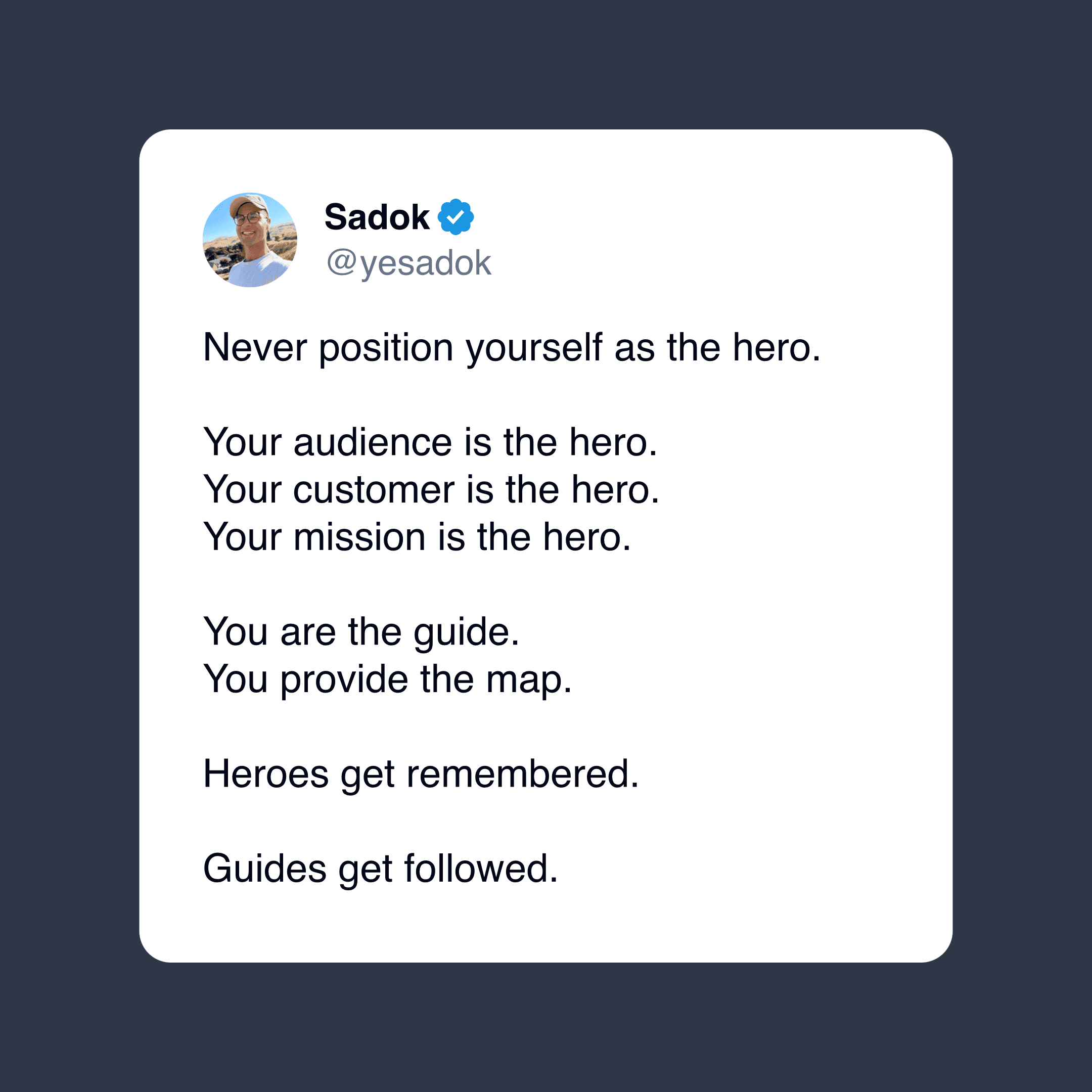
Never Be the Hero
Most people misunderstand leadership.
They think it’s about visibility.
Being impressive.
Being the person in the room with the answers.
That instinct is natural—and wrong.
The fastest way to lose trust is to make yourself the hero.
The Hero Trap
When you position yourself as the hero, a few things happen immediately:
Your audience becomes passive
Your team waits for direction instead of ownership
Your customers feel sold to, not supported
Heroes take up oxygen.
And leadership isn’t about being admired—it’s about being trusted.
Who the Real Hero Is
If you’re leading something real, the hero is never you.
Your audience is the hero.
Your customer is the hero.
Your team is the hero.
Your mission is the hero.
They’re the ones taking the risk.
They’re the ones doing the work.
They’re the ones who have to win.
The Quiet Role of a Leader
Your role is quieter—and far more powerful.
You’re the guide.
You don’t steal the spotlight.
You don’t need to narrate your importance.
You don’t need to be the smartest person in the room.
Instead:
You provide the map.
You remove friction.
You clarify direction.
You make winning inevitable.
That’s real leverage.
Why Guides Win Long-Term
Heroes get remembered.
Guides get followed.
And there’s a critical difference.
People remember heroes from a distance.
They follow guides up close.
Followers don’t come from charisma.
They come from clarity.
When people trust that you’re there to help them win—not to win through them—momentum compounds naturally.
What This Looks Like in Practice
In leadership, this means:
Designing systems that work without you
Making others look capable, not dependent
Measuring success by outcomes, not attention
In business, it means:
Selling transformation, not ego
Teaching customers how to succeed without constant hand-holding
Building trust before asking for anything in return
In life, it means:
Fewer speeches, more direction
Less performance, more presence
Final Thought
Being the hero feels good in the short term.
Being the guide builds something that lasts.
And in the long run, being followed beats being admired—every time.
Read essay →
Back to Home